
Stanley SXPW14E/16E Mode-D-Emploi
Manuel PDF · 280 Pages
Français



Vérification rapide
Réponse incorrecte, veuillez réessayer.
Discutez avec votre manuel Stanley SXPW14E/16E grâce à l'IA
Obtenez des réponses instantanées par IA à partir de votre manuel Stanley SXPW14E/16E
Posez toutes vos questions concernant le Stanley SXPW14E/16E. Les réponses proviennent de ce manuel, avec les pages dont elles sont tirées.
SXPW14E/16E Programme d'entretien
Vérifier que toutes les vis sont bien serrées et contrôler la présence de pièces cassées ou usées avant chaque utilisation.
Inspecter le filtre d'arrivée (L) et le filtre à détergent si installé. Les nettoyer selon les instructions si nécessaire.
Déconnecter la lance et retirer les dépôts de saleté de l'orifice de la buse à l'aide de l'outil de nettoyage fourni (C1).
Faire fonctionner l'appareil avec un liquide antigel non corrosif et non toxique avant de le ranger dans un endroit sec, protégé du gel.
Poser une Question
Recommandez-vous SXPW14E/16E?
Oui NonFoire aux Questions
The product information covers Stanley SXPW25DTS and SXPW27DTS high-pressure washer models. They offer 2.5 kW and 2.7 kW rated power respectively, with different maximum pressure and flow ratings.
Cette réponse est-elle utile?
It is intended for individual cleaning of vehicles, machines, boats, masonry, garden equipment, and similar durable surfaces. Use clean water and biodegradable detergents. Engine cleaning is only appropriate where contaminated water can be disposed of according to local rules.
Cette réponse est-elle utile?
Regular mode is intended for standard washing tasks. Heavy-duty mode raises cleaning force by 50% for more demanding grime. On large areas, a compatible Twin Nozzle adapter can use two nozzles simultaneously to reduce working time.
Cette réponse est-elle utile?
Yes. Use highly biodegradable detergent supplied or recommended for the washer. Select the detergent nozzle setting or fit the detergent accessory where provided. Avoid using overly thick detergent, and dilute it with water if needed.
Cette réponse est-elle utile?
Direct connection is permitted only when the supply hose has a compliant backflow preventer with drain facility. Follow local water authority requirements. Water that has passed through a backflow preventer is considered non-potable.
Cette réponse est-elle utile?
Use the lowest suitable pressure near wheels and tyres, keep the jet at least 30 cm away, and never aim directly at tyres. Do not use the turbo lance on vehicle parts. Avoid fine jet settings and rotating nozzles on delicate or painted surfaces.
Cette réponse est-elle utile?
Turn off the water, discharge residual pressure, switch off, unplug, empty and rinse the detergent tank, and engage the gun safety catch. Store the unit in a dry location protected from frost. Use non-toxic, non-corrosive antifreeze before winter storage if necessary.
Cette réponse est-elle utile?
Avantages et Inconvénients
Avantages

- Strong output: up to 16 MPa maximum pressure and 14.16 L/min maximum flow, depending on model.
- Two cleaning modes provide regular operation and heavy-duty cleaning with up to 50% more cleaning force.
- TSS models automatically stop the motor when the trigger is released, supporting efficient use.
- Adjustable nozzle, detergent control, and optional accessories improve versatility across cleaning tasks.
- Designed for vehicles, masonry, boats, machines, and outdoor surfaces using clean water and biodegradable detergent.
Inconvénients

- High pressure can damage tyres, painted finishes, delicate materials, and pressurized components if used incorrectly.
- Requires careful electrical and water-supply setup, including suitable outdoor extension leads and protection.
- Detergent suction may weaken or stop when using longer high-pressure hoses or hose extensions.
- The rotating nozzle may reduce pressure by about 25% compared with an adjustable nozzle.
- Noise levels can reach 95 to 97 dB(A), so hearing protection is recommended.
Produit Spécification
Mode de fonctionnement
Eau froide
Temperature d'entree
max. 50 degres C
Mobilite
Chariot
Description du Produit
Nettoyeur haute pression Stanley - Lire, telecharger et imprimer gratuitement
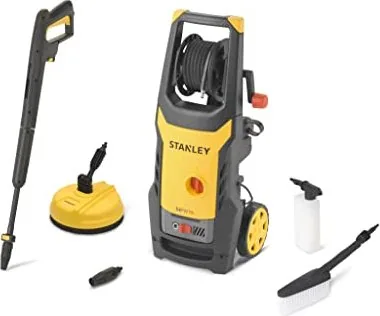
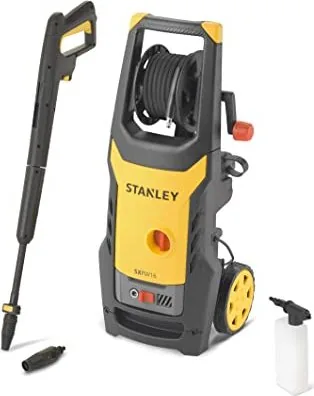
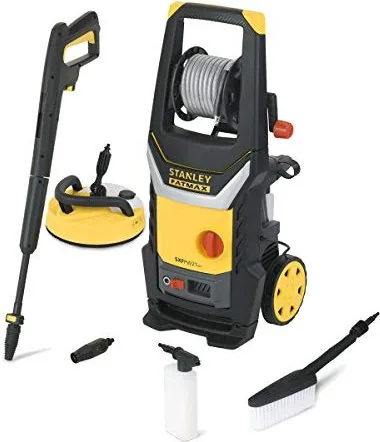
Le nettoyeur haute pression Stanley est une solution de nettoyage pratique pour les travaux exterieurs exigeants autour de la maison. Concu pour laver les vehicules, les terrasses, le mobilier de jardin, les allees, les murs et d'autres surfaces exterieures resistantes, il associe un format compact a une forte pression d'eau pour eliminer efficacement la salete incrustee. Son moteur de 2,1 kW fournit une pression de service de 11 MPa, avec une pression maximale de 14,5 MPa, aidant les utilisateurs a retirer la boue, la poussiere, les algues et les saletes tenaces.
Concu pour un nettoyage exterieur polyvalent
Avec un debit d'eau de 6 litres par minute et un debit maximal de 7,5 litres par minute, ce nettoyeur equilibre la puissance de nettoyage et une utilisation maitrisee de l'eau. La buse reglable permet aux utilisateurs de modifier le type de jet selon les travaux, tandis que l'utilisation de detergent compatible aide a decoller la salete avant le rincage. Pour les zones tres sales, une buse rotative optionnelle peut offrir une action de nettoyage plus intensive.
Le nettoyeur est prevu pour etre utilise avec de l'eau propre ou filtree et des detergents biodegradables recommandes pour les nettoyeurs haute pression. Il peut etre raccorde a une arrivee d'eau adaptee ou aspirer l'eau d'un recipient ouvert lorsque la configuration d'aspiration appropriee est utilisee. Cette flexibilite est utile pour les taches de nettoyage courantes dans les allees, les garages, les jardins et les zones de travail exterieures.
Caracteristiques pratiques et utilisation en toute securite
L'appareil comprend un flexible haute pression, un pistolet-gachette, une lance, un filtre a eau et des mecanismes de securite concus pour favoriser une utilisation controlee. Selon la configuration, les accessoires peuvent inclure une buse rotative, une brosse, un enrouleur de flexible, un kit de detergent, un deboucheur de canalisation ou un accessoire de nettoyage pour grandes surfaces. Un verrouillage de gachette aide a prevenir toute activation accidentelle, tandis que la protection thermique est concue pour arreter le moteur en cas de surcharge.
Pour de meilleurs resultats, appliquez le detergent sur une surface seche, laissez-le agir brievement et rincez de bas en haut sur les surfaces verticales. Gardez le jet a au moins 30 cm des surfaces, en particulier des finitions peintes, des materiaux fragiles, des pneus, des valves et d'autres composants sous pression. Le jet haute pression est puissant et ne doit jamais etre dirige vers des personnes, des animaux, des equipements electriques ou le nettoyeur lui-meme.
Entretien et rangement
Un entretien simple peut aider a maintenir des performances fiables. Verifiez et nettoyez le filtre a eau avant utilisation, retirez les debris de la buse si necessaire et inspectez regulierement les flexibles, les raccords et les joints. Relachez toujours la pression residuelle, eteignez et debranchez le nettoyeur avant le nettoyage, le reglage, le transport ou le rangement. Par temps froid, protegez l'appareil du gel en le rangeant dans un endroit sec et a l'abri du gel.
Remarques
- Utilisez uniquement des flexibles, raccords, detergents et pieces de rechange approuves.
- Maintenez les personnes et les animaux a au moins 15 m de la zone de travail.
- Ne faites pas fonctionner le nettoyeur sans alimentation en eau raccordee.
- Verifiez les regles locales avant de raccorder directement l'appareil a des reseaux d'eau potable.
Rechercher 67 732 Manuels en ligne


Tapez la marque ou le modèle