Manual.ly Logo

JBL Aquaristic ProAquaTest Lab Mode-D-Emploi

0,0 · 0 Notes

Manuel PDF · 65 Pages

Français

M: QW-35-FL
page

/ 65

Loading...
20bbaef5bdec311f8d8e156c4e1fe9d6e449 page 9
16 17
deciency. Iron and some other trace elements are only sta-
ble in water for a limited time, even if they are bound to so-
called chelators, as is usual in modern fertilisers. In addition
any tap water added is usually iron-free. Therefore, the iron
content needs to be monitored regularly with this test and re-
plenished if necessary. Cncentrations as low as 0.1–0.2 mg/l
are sufcient for good plant growth. In very densely planted
aquariums, values of up to 0.6 mg/l can also be useful. In
marine water, values of up to 0.05 mg/l are recommended.
Procedure:
1. Rinse both test vials several times with the water to be
tested.
2. Use the enclosed syringe to ll each of the test vials with
5 ml of sample water.
3. Add 5 drops of Fe reagent to one of the two test vials and
mix by swirling. Allow to stand for 10 minutes until the
colour has developed completely.
4. Place both test vials in the grey comparator block: Place
the vial with added reagent at the smooth end and the
vial with untreated sample water (blank sample) at the
notched end of the comparator block.
5. Place the comparator block with the two test vials on the
colour chart in such a way that the notch points to the
values and move it on the colour chart until the colour of
the sample mixed with reagents corresponds as closely
as possible to the colour under the blank sample.
6. Read the iron content in the notch of the comparator.
Note:If you decide to use the JBL PRO AQUATEST NH
4
at
the same time, make sure you don’t mix up the measuring
vessels of either set. Traces of the JBL PRO AQUATEST
NH
4
left inside the measuring vessel may result in too high
readings in the iron test.
Correcting deviating values:
Too low: Fertilise with ferrous fertilisers from the JBL ferti-
liser range (e.g. JBL Ferropol).
Too high: Carry out the corresponding partial water change.
JBL PRO AQUATEST K
Features: JBL PRO AQUATEST K is an easy-to-use turbid-
ity test for the routine monitoring of the potassium content in
fresh and marine water.
Why test? Potassium is one of the macroelements which is
very effectively absorbed within a few hours and temporarily
stored by plants in fresh water. Growing plants require more
potassium compared to other elements. As a result, potas-
sium concentrations can drop to a minimum range, causing
plant growth to stagnate, even if the aquarium water is ferti-
lised regularly. Potassium deciency initially leads to chloro-
tic spots on the edges of the leaf, which gradually increase
and then turn into grey-brown necroses. The leaves may
crinkle or curl. In Central European tap water, potassium is
usually a decient element compared to in natural biotopes
and this especially applies to calcium and magnesium con-
centrations. For good plant growth, the potassium content
needs to be at around 10 mg/l, in aquariums with high il-
lumination (e.g. in so-called scapes) up to 30 mg/l can be
useful. Higher potassium values in aquarium water encour-
age the growth of green thread algae. Potassium is present
in seawater in concentrations of about 380–400 mg/l, but is
only consumed in small quantities. Excessively high potas-
sium contents can be dangerous for sensitive animals such
as shrimps. The potassium content of the aquarium water
needs to be measured on a daily basis initially. This enables
the needs of the plants to be determined and the dosage of
the fertiliser can be carried out accordingly. Afterwards, rou-
tine measurements can be carried out after longer intervals.
Procedure:
Freshwater:
1. Rinse the measuring tube (plastic) and the tube (glass)
for the potassium content reading several times with the
water to be tested.
2. Using the syringe supplied, ll 15 ml of sample water into
the measuring tube.
3. Add 10 drops of reagent 1 and mix by swirling.
4. Add 1 large level measuring spoon (broad end of the
enclosed double-ended spoon) of reagent 2 and swivel
slightly for about 30 seconds until the powder has dis-
solved. The water becomes whitish and cloudy. Leave to
stand for 1 minute and then swirl slightly again.
5. Place the glass tube for reading the potassium content
reading on the cross of the colour card.
6. The following procedure should be carried out in bright,
diffuse light. Pour the´ turbid water from the measuring
tube into the reading tube until the turbidity means the
cross on the colour card is no longer visible from above.
7. The potassium content can now be read on the scale of
the tube (bottom of the meniscus).
Marine water:
1. Fill 10 ml sample water with distilled water to 300 ml.
2. Follow the same steps as for fresh water.
3. Multiply the test result by a factor of 30.
Correcting deviating values:
Too low: In freshwater aquariums fertilise with potassium-
containing fertilisers from the JBL ProScape range. We do
not recommend an additional dosage in marine water be-
cause potassium is toxic for various organisms.
Too high: Repeat the measurement after 24 hours. If the
value is still too high, carry out the corresponding partial
water change.
JBL PRO AQUATEST Cu
Features: JBL PRO AQUATEST Cu is an easy-to-use color-
imetric test to routinely determine the copper content in fresh
and marine water aquariums, and in garden ponds. A com-
pensation method developed by JBL allows reliable results
to be obtained even in slightly discoloured water (caused by
peat ltering or disease treatment etc.).
Why test? Copper is a heavy metal which is on the one
hand indispensable as a trace element for plant and animal
organisms. On the other hand it has a devastating effect
as a cell poison (cytotoxin) above a certain concentration.
Copper mainly reaches the aquarium in tap water, as cop-
per pipes were often used for water installation. If the water
remains in such pipes for a longer period of time, consid-
erable amounts of copper can dissolve. The water in the
pipe should therefore be drained before use. For the same
reason, do not use rainwater that has owed over copper
gutters. And make sure the tools you use when setting up
your aquarium or pond are copper-free. A controlled entry
of copper takes place through the application of medications
against parasitic sh diseases, as well as with some algae-
killing agents. The copper concentrations prescribed for this
can be tolerated by sh for a certain time while parasites,
etc., start dying off immediately.
Please note: Copper quickly forms water-insoluble com-
pounds which form deposits on the ground. The JBL PRO
AQUATEST Cu only detects copper dissolved in water.
Procedure:
1. Rinse both test vials several times with the water to be
tested.
2. Use the enclosed syringe to ll each of the test vials with
5 ml of sample water.
3. Add 5 drops of reagent 1 to one of the two test vials and
mix by swirling. Then add 5 drops of reagent 2 and mix
again. Allow to stand for 15 minutes until the full colouring
develops.
4. Place both test vials in the grey comparator block: Place
the vial with added reagent at the smooth end and the
vial with untreated sample water (blank sample) at the
notched end of the comparator block.
5. Place the comparator block with the two test vials on the
colour chart in such a way that the notch points to the
values and move it on the colour chart until the colour of
the sample mixed with reagents corresponds as closely
as possible to the colour under the blank sample.
6. Read the copper content in the notch of the comparator.
Correcting deviating values:
Too low: The value should always remain below the detec-
tion limit (except for some special treatments).
Too high: Regular use of JBL water conditioners, such as
JBL Biotopol or ltering with JBL’s high performance acti-
vated carbon. Water-insoluble copper compounds can only
be eliminated by removing the complete substrate.
JBL PRO AQUATEST O
2
Features: JBL PRO AQUATEST O
2
is an easy-to-use colori-
metric test for the routine monitoring of the oxygen content
in fresh and marine water aquariums, and in tap and garden
pond water, within a range of 1–10 mg/l (ppm).
Why test? All animals living in water need oxygen to
breathe. Even the „invisible helpers“ in aquariums and
ponds, the cleansing bacteria, are dependent on a suf-
cient oxygen content for the conversion of ammonium to
nitrate. The oxygen supply they need can be safeguarded
by adequate planting. In aquariums and ponds with little or
no planting and in marine aquariums, the oxygen content
always needs to be kept at the appropriate saturation value
with the help of technical equipment. The saturation value
depends on the water temperature (see table on last page).
Plants are able to exceed this saturation value through their
assimilation activity. In well planted aquariums and ponds,
for example, values can be found towards the end of the
lighting period, which are 1 to 2 mg/l higher than the satura-
tion value.
Procedure:
1. Rinse the measuring vessel several times with the water
to be tested.
2. Fill the measuring vessel to the brim with the water to be
tested by immersing it in water and place it on a water-
proof surface.
3. Add 6 drops of O
2
reagent 1 and 6 drops of O
2
reagent
2 slowly one after the other, until the measuring vessel
overows.
4. Avoiding bubble formation, close the measuring vessel
bubble-free with the enclosed cap and shake vigorously
for approx. 30 seconds.
5. Remove the cap from the measuring vessel and add 6
drops of O
2
Reagent 3.
6. Close the measuring vessel again (bubbles no longer
matter) and shake vigorously for approx. 30 seconds. Al-
low to stand for 10 minutes until the full colouring devel-
ops.
7. Move the measuring vessel back and forth approx. 3–5
cm above the white part of the colour chart and select the
colour with the best possible match.
8. Read the oxygen content off the relevant colour eld.
Correcting deviating values:
Too low: Put in more plants and/or improve care of exist-
ing plants, e.g. by installing a CO
2
supply unit (JBL ProFlora
CO
2
kit). Improve ventilation, e.g. with a JBL ProSilent air
pump and/or improve water movement on the surface with
ow pumps, protein skimmers (marine water) or in garden
ponds with stronger pumps (pond lters) in conjunction with
a waterfall or watercourse.
Too high: Not applicable.
JBL PRO AQUATEST CO
2
Direct
Features: JBL PRO AQUATEST Ca is an easy-to-use titra-
tion test to determine the carbon dioxide content of fresh-
water.
Why test? Carbon dioxide (CO
2
) is the most important plant
nutrient. The consumption of CO
2
differs from aquarium to
aquarium and depends, amongst other things, on the fol-
lowing factors: number and demands of plants, carbonate
hardness, water movement and light. Fertilisation with CO
2
is usually done with a CO
2
fertiliser system. In the aquarium
water, a CO
2
content between 15 and 30 mg / l is recom-
mended. This range is safe for sh and at the same time en-
sures luxuriant plant growth. 20–25 mg/l CO
2
has proven to
be ideal. In special aquariums with a large number of plants,
so-called scapes, higher values of up to 35 mg/l may be re-
quired. With this test you can determine the CO
2
content of
your aquarium water in mg/l and thus monitor the setting of
your CO
2
fertiliser system.
Please note: When fertilising with so-called liquid carbon,
fertiliser monitoring with JBL PRO AQUATEST CO
2
Direct is
not possible because these fertilisers do not contain CO
2
but
other carbon compounds.
Procedure:
1. Rinse the measuring vessel and syringe several times
with the water to be tested.
2. Using the syringe, insert 20 ml of bubble-free sample
water into the measuring tubes.
3. Place the measuring tube on both elds of the enclosed
colour chart.
4. Pour 5 drops of reagent 1 into the measuring tube on the
white eld and swirl it until it is mixed.
5. Add reagent 2 drop by drop. After each drop, swirl and
count the drops until a pink colour is obtained which re-
mains stable for 60 seconds and corresponds to the col-
our in the second measuring tube on the pink colour eld.
To compare the colours, look into the tubes from above.
6. The number of drops multiplied by 2 gives the carbon di-
oxide content in mg/l. Example: 10 drops of reagent 2 =
20 mg/l CO
2
.
Since other acids in the water impair the measurement, a
blank value must also be determined. To do this, take a wa-
ter sample of 100 ml and aerate it for 15 min using a JBL
ProSilent air pump with an air stone. Then determine the
blank value according to the instructions given above.
Result–blank value = actual carbon dioxide concentration
in mg/l.
Correcting deviating CO
2
values:
Too low: Add carbon dioxide to the aquarium using a JBL
ProFlora CO
2
fertiliser system.
Too high: Aerate the aquarium using a JBL ProSilent air
pump.
CO
2
table
Special feature: The CO
2
table enables you to determine
the carbon dioxide content through the carbonate hardness
(KH) and the pH value of the water. This method should only
be used if no pH-lowering substances, such as nitrate or
peat, are in the water.
Why test?
Carbon dioxide (CO
2
) is the most important plant nutrient.
The consumption of CO
2
differs from aquarium to aquarium
and depends, amongst other things, on the following factors:
number and demands of plants, carbonate hardness, water
movement and light. Fertilisation with CO
2
is usually done
en
en
en
en
en

Discutez avec votre manuel JBL Aquaristic ProAquaTest Lab grâce à l'IA

Obtenez des réponses instantanées par IA à partir de votre manuel JBL Aquaristic ProAquaTest Lab

Posez toutes vos questions concernant le JBL Aquaristic ProAquaTest Lab. Les réponses proviennent de ce manuel, avec les pages dont elles sont tirées.

ProAquaTest Lab Programme d'entretien

Quotidien
Mesurer la teneur en magnésium dans l'aquarium d'eau douce

Mesurer quotidiennement au début pour déterminer les besoins des plantes et le dosage de l'engrais. Passer ensuite à des intervalles plus longs.

Quotidien
Mesurer la teneur en potassium dans l'aquarium d'eau douce

Mesurer quotidiennement au début pour déterminer les besoins des plantes et le dosage de l'engrais. Passer ensuite à des intervalles plus longs.

M: qwen/qwen3.8-flash

Poser une Question

0/1000

Recommandez-vous ProAquaTest Lab?

Oui Non

Foire aux Questions

A

Assurez-vous d'obtenir des résultats précis en rinçant tous les vaisseaux plusieurs fois avec l'eau de l'échantillon avant le test. Tenez les compte-gouttes verticalement pour éviter les bulles d'air. Suivez les temps d'attente spécifiques pour le développement de la couleur. Comparez les couleurs contre le tableau sur un fond blanc. Utilisez les seringues et les blocs comparateurs fournis pour des volumes constants.

Cette réponse est-elle utile?

A

Les fluctuations du pH peuvent nuire aux organismes aquatiques. Les changements soudains sont particulièrement stressants. L'eau décolorée peut interférer avec les lectures mais les méthodes de compensation aident. Mesurez toujours à la même heure de la journée car la lumière affecte les niveaux de CO2 et le pH. Évitez de tester immédiatement après avoir ajouté des produits chimiques ou de la nourriture.

Cette réponse est-elle utile?

A

Vérifiez les paramètres critiques comme le pH et l'ammoniac régulièrement surtout dans les nouveaux systèmes. Testez les nutriments comme le nitrate et le phosphate mensuellement une fois le système stable. Vérifiez la GH et la KH hebdomadairement pour surveiller les tendances de dureté. Testez les niveaux d'oxygène si les poissons montrent des signes de détresse ou dans des aquariums fortement peuplés. La fréquence dépend de la densité de peuplement et de la taille du réservoir.

Cette réponse est-elle utile?

A

Oui le manuel couvre les aquariums d'eau douce les aquariums marins et les étangs de jardin. Des tests spécifiques existent pour les étangs à Koi avec une forte densité de stock. Les tests de dureté générale et de pH s'appliquent à la plupart des environnements d'eau douce. Les tests CO2 sont spécifiques aux aquariums plantés avec des cycles de croissance végétale actifs.

Cette réponse est-elle utile?

A

Un taux élevé d'ammoniaque indique un problème de filtre biologique. Effectuez un changement d'eau partiel important immédiatement. Ajoutez des bactéries bénéfiques pour rétablir le cycle de l'azote. Vérifiez si les médicaments utilisés récemment ont nui aux bactéries bénéfiques. Assurez-vous que l'alimentation est réduite jusqu'à ce que les niveaux reviennent à des limites sûres. Surveillez le pH car il affecte les niveaux de toxicité de l'ammoniaque.

Cette réponse est-elle utile?

A

Corrigez la faible dureté carbonatée en ajoutant des conditionneurs d'eau JBL contenant des hydrogénocarbonates. Vous pouvez également utiliser des mélanges de sels minéraux conçus pour les aquariums. Évitez de ramollir l'eau si elle est déjà trop basse. Surveillez de près après ajustement pour prévenir les variations de pH. Testez à nouveau après 24 heures pour confirmer la stabilité.

Cette réponse est-elle utile?

A

Stockez les réactifs secs à température ambiante dans leur emballage d'origine. Gardez-les à l'écart de la lumière directe du soleil et des sources de chaleur. Assurez-vous que les compte-gouttes sont secs à l'extérieur avant de les remettre dans les flacons. Ne mélangez pas les bouchons entre différentes boîtes de test. Vérifiez régulièrement les dates d'expiration car les vieux réactifs peuvent donner des résultats inexact.

Cette réponse est-elle utile?

M: QW-35-FL

Avantages et Inconvénients

Avantages

  • Gamme complète de tests couvrant tous les paramètres clés pour des installations aquatiques diversifiées incluant eau douce marine et étangs de jardin
  • Technologie de compensation sophistiquée garantit des résultats fiables même dans l'eau décolorée par le filtrage à la tourbe ou des traitements
  • Procédures détaillées minimisent les erreurs de l'utilisateur et incluent des aides visuelles comme des tableaux de couleurs pour une interprétation facile des mesures
  • Les réactifs sont stables et efficaces lorsqu'ils sont stockés correctement permettant une surveillance cohérente à long terme de la chimie de l'eau
  • Des outils spécifiques fournis simplifient le processus de test le rendant accessible aux débutants tout en restant précis pour les experts
VS

Inconvénients

  • Certains tests nécessitent des lectures de couleur dans les 15 minutes pour assurer la précision avant que la couleur de la solution ne change
  • Les utilisateurs doivent s'assurer que les vaisseaux de test ne sont pas mélangés entre différentes boîtes de test pour éviter la contamination croisée des échantillons
  • La précision dépend du comptage précis des gouttes et du maintien des compte-gouttes verticalement ce qui nécessite de l'attention aux détails
  • La correction des niveaux élevés de toxines nécessite souvent des changements d'eau immédiats à grand volume ce qui peut être perturbant
  • Les réactifs peuvent se dégrader avec le temps si ils ne sont pas stockés dans l'emballage d'origine à l'écart des sources de chaleur et d'humidité
M: QW-35-FL

Produit Spécification

Gamme

Valeurs de l'eau

Type

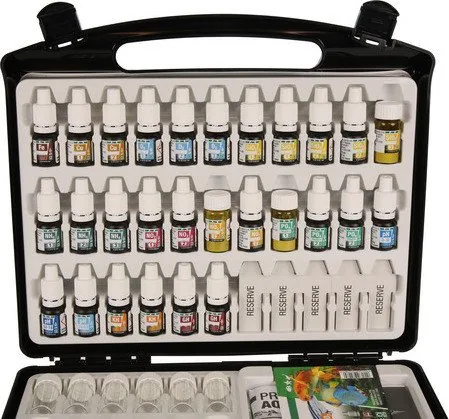
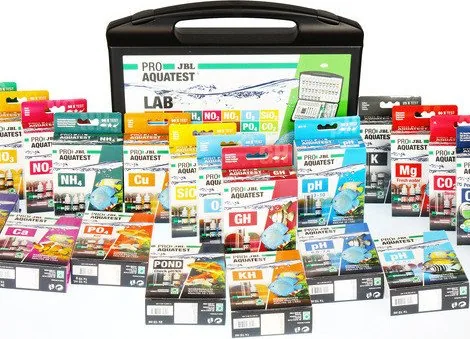
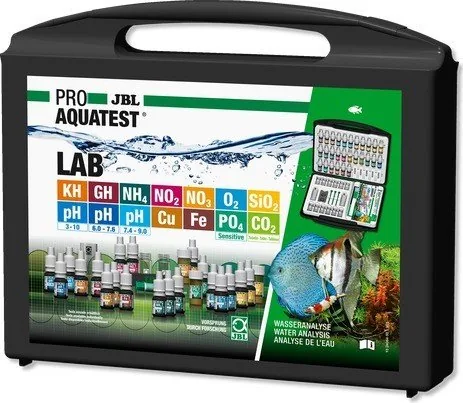
Test d'eau (pH (3 plages), Dureté carbonatée, Dureté totale, Phosphate, Nitrite, Nitrate, Fer, Cuivre, Silicate, Oxygène, Ammonium, Ammoniaque, CO2 indirect), Kit d'essai

Dimensions

38,20x8,51x31,80 cm (LxHxP)

Poids

1,27 kg

M: QW-35-FL

Description du Produit

Maîtriser la chimie de l'eau en aquarium

Maintenir un environnement aquatique sain nécessite un suivi précis de la chimie de l'eau pour garantir le bien-être de tous les organismes qui y vivent. Le manuel du JBL Pro AquaTest Lab Kit de test fournit des conseils essentiels pour les passionnés qui exigent l'excellence dans leurs installations aquatiques pour maintenir un état optimal. Cette collection complète garantit que vos poissons et plantes prospèrent dans des conditions optimales en fournissant des instructions détaillées pour diverses méthodes d'analyse utilisées aujourd'hui.

Méthodes essentielles de test pour la clarté

La qualité de l'eau détermine le succès de tout système d'aquarium quelle que soit l'espèce spécifique que vous gardez. Que vous gardiez de la vie marine d'eau douce ou des poissons Koi d'étang de jardin, différents paramètres nécessitent une attention spécifique pour la stabilité. Le manuel détaille des méthodes de titrage et colorimétriques sophistiquées conçues pour la précision et la facilité d'utilisation pour tous. Les tests de titrage comme KH et GH utilisent des comptages précis de gouttes pour déterminer les niveaux de dureté efficacement dans le temps. Les tests colorimétriques tels que le pH et les nutriments essentiels s'appuient sur des tableaux de couleurs pour des résultats clairs et lisibles pour des vérifications rapides. Chaque test comprend des procédures étape par étape pour minimiser les erreurs de l'utilisateur lors du processus de test des échantillons d'eau. Le système compense efficacement la décoloration de l'eau causée par le filtrage à la tourbe ou le traitement assurant une fiabilité même dans des conditions difficiles.

Paramètres vitaux couverts pour la santé

Comprendre votre profil d'eau est crucial pour prévenir des fluctuations dangereuses qui nuisent aux créatures sensibles. Les tests de dureté comme le Pro AQUATEST GH et KH préviennent les variations dangereuses de pH qui nuisent considérablement aux créatures sensibles. Les niveaux de pH entre des plages spécifiques conviennent parfaitement à différentes espèces des eaux douces acides aux réservoirs marins alcalins. Le test des nutriments surveille des cycles d'azote complexes comme l'Ammoniaque, le Nitrite et le Nitrate pour suivre la fonction du système avec précision. Les niveaux de Phosphate et de Silicate aident à prévenir les floraisons d'algue tenaces qui peuvent étouffer votre réservoir et tuer les poissons. Les éléments trace comme le Fer et le Cuivre sont vitaux pour la croissance mais doivent être contrôlés strictement pour éviter les risques de toxicité. Les niveaux d'oxygène assurent le support de vie aux poissons et bactéries tandis que la fertilisation au CO2 aide la croissance luxuriante des plantes dans les réservoirs plantés.

Maintenance et corrections pour la stabilité

Maintenir les paramètres stables évite le stress et les épidémies de maladie dans votre écosystème sur le long terme. Si les valeurs s'écartent des plages recommandées, le guide offre des étapes de correction spécifiques pour l'ajustement afin de réparer les problèmes. Une dureté trop basse nécessite l'ajout de sels minéraux tandis qu'un excès suggère d'utiliser la filtration par osmose inverse pour la réduire. Les carences en nutriments nécessitent des engrais spécifiques de la gamme ProScape disponibles pour achat en ligne facilement. Les niveaux de toxines élevés nécessitent des changements d'eau immédiats ou l'introduction de filtres biologiques pour rétablir l'équilibre rapidement. Les instructions de stockage garantissent que les réactifs restent efficaces pour les périodes futures de test avant leur expiration. Les compte-gouttes doivent être tenus verticalement pour éviter les bulles d'air lors de la distribution des réactifs. Un suivi régulier évite les surprises inattendues dans votre routine de maintenance pour vos réservoirs. En suivant les conseils du manuel JBL Pro AquaTest Lab Kit de test, les propriétaires d'aquarium peuvent atteindre la clarté de l'eau et la stabilité pour leurs animaux de compagnie.

M: QW-35-FL

© Copyright 2026 Manual.ly